


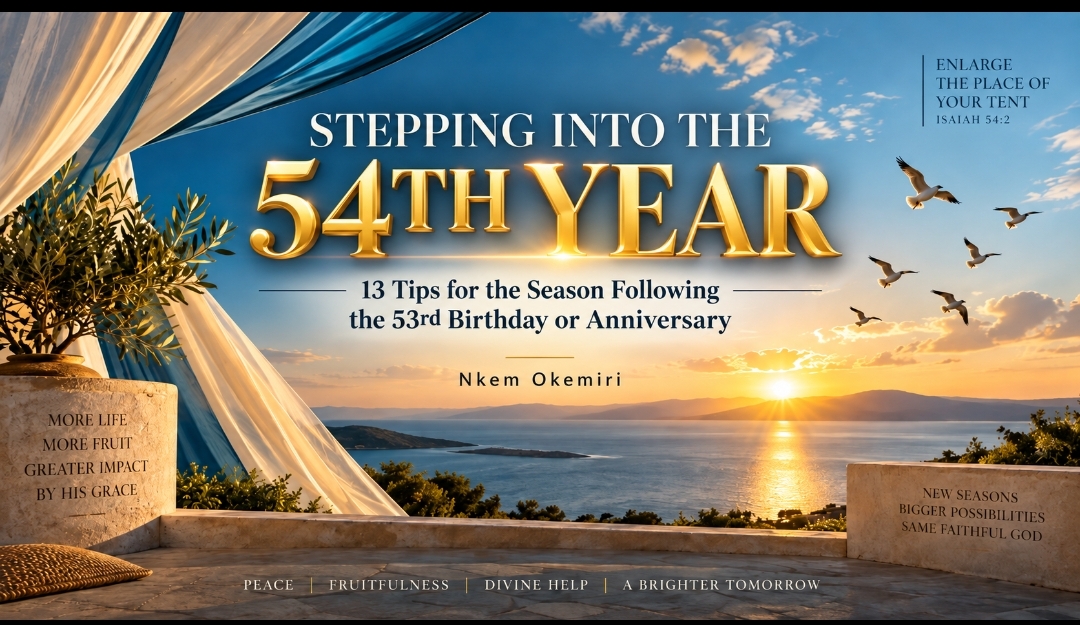
What might the Bible teach us as we step into the fifty-fourth year? Drawing from 1 Timothy, Psalm 54, Isaiah 54 and the fifth day of creation, Nkem Okemiri shares 13 counsels for enlargement, fruitfulness, stewardship, peace, multiplication and new possibilities.
Completing fifty-three years and stepping into the fifty-fourth year is a significant transition. Whether the occasion is a fifty-third birthday, a fifty-third wedding anniversary, or the anniversary of a ministry, church, business, organization, institution or other important undertaking, the beginning of the fifty-fourth year provides an opportunity to look back with gratitude and forward with expectation. Fifty-three completed years represent a substantial history. Much has already been experienced, learned, built, lost, recovered, corrected and established. Yet the biblical patterns associated with fifty-four suggest that this need not be merely a season of preserving what already exists. It may also be a season in which new dimensions of life, usefulness, fruitfulness, responsibility and enlargement begin to emerge.
Several portions of Scripture provide useful light for reflecting on such a season. The fifty-fourth book of the Bible, 1 Timothy, is concerned with maturity, stewardship, leadership, character, sound doctrine, relationships, responsibility, example and the faithful handling of what has been entrusted to us. Psalm 54 presents God as Helper and Sustainer in a season of pressure and opposition. Isaiah 54 speaks powerfully about fruitfulness after barrenness, enlargement after limitation, freedom from shame, divine compassion, peace, security and a future that can become larger than the past.
There is another interesting correspondence. The fifty-fourth year is the fifth year within the eighth seven-year period of life, covering the years fifty through fifty-six. The fifth day of creation therefore provides another biblical picture worth considering. On that day, God introduced living creatures into the seas and birds into the heavens. Creation entered a new stage characterized by movement, abundant life, blessing, fruitfulness and multiplication. Things appeared that had not existed during the previous four days.
These biblical patterns should not be treated as mechanical predictions of what must happen in anyone’s fifty-fourth year. Scripture does not teach that the events of a person’s life are predetermined by the numerical correspondence of a particular age. The patterns can, however, provide meaningful themes for prayer, reflection, preparation and wise living. With that understanding, the fifty-fourth year may be approached as a season of new possibilities, enlargement, fruitfulness, responsible stewardship, renewed usefulness, divine help, peace and mature contribution.
1. REMAIN OPEN TO NEW THINGS
The fifth day of creation introduced something genuinely new into the developing world. Genesis 1:20–23 records the appearance of living creatures moving through the waters and birds flying across the heavens. Earlier days had brought light, the firmament, seas, land and vegetation, but the fifth day opened another dimension of creation. The environment became filled with mobile living creatures possessing capacities that had not previously appeared.
This is a helpful picture for anyone entering the fifty-fourth year. Longevity can sometimes tempt us to assume that the important beginnings of life belong mainly to the past. After fifty-three years, a person may imagine that most of the significant discoveries, relationships, assignments and possibilities that will ever come have already appeared. A marriage, ministry, church, business or organization of the same age may similarly become accustomed to established routines and familiar ways of doing things.
The fifth-day pattern challenges that assumption. God is not restricted to repeating what He has already done. There may still be new friendships to form, new knowledge to acquire, new places to enter, new responsibilities to accept, new ventures to explore and new expressions of long-established gifts to discover. Some things may become possible now precisely because of what the previous fifty-three years have produced.
Do not enter the fifty-fourth year asking only, “How do I preserve what I already have?” Also ask, “What may now be possible that was not possible before?” A long history should provide a foundation for the future, not become a wall against it.
2. ENLARGE THE TENT BEFORE THE INCREASE COMES
One of the dominant messages of Isaiah 54 is enlargement. Israel is told to “enlarge the place of thy tent,” stretch out the curtains, lengthen the cords and strengthen the stakes. The picture is remarkable because preparation for expansion is required before the expansion has fully materialized.
The principle is important. Sometimes greater opportunities require greater capacity before they require greater activity. A person may need broader knowledge, stronger relationships, better systems, more disciplined financial management, improved health habits or greater emotional and spiritual capacity. A marriage may need new ways of communicating as life enters another stage. A ministry may require stronger structures. A business may need improved processes, technology or leadership development. An organization may need to prepare more people to carry responsibilities that have previously been concentrated in the hands of a few.
Entering the fifty-fourth year is therefore a good time to examine the size of the present “tent.” If tomorrow became larger than today, would your existing structures be capable of carrying it? If new opportunities arrived, would you have the capacity to receive them without damaging what has already been built?
Enlargement is not simply about receiving more. It is also about becoming capable of responsibly handling more.
3. STRENGTHEN THE STAKES WHILE LENGTHENING THE CORDS
Isaiah 54 does not speak only about expansion. It commands the people to lengthen their cords and strengthen their stakes. Enlargement without strengthening can create instability. Growth must therefore be accompanied by reinforcement.
This balance becomes especially important after many years of life or operation. The fifty-fourth year may bring opportunities for growth, but growth should not be pursued at the expense of foundations. A person reaching for new opportunities should also protect health, character, family, spiritual life and financial stability. A marriage seeking fresh experiences should continue strengthening trust, communication and companionship. A ministry desiring greater reach must also strengthen accountability, doctrine and leadership. A business pursuing expansion must strengthen its finances, systems, people and customer relationships.
Some things may need to become larger, while other things need to become deeper. Some structures must stretch, while others must be reinforced. The wisdom of Isaiah 54 is that both must happen together.
Do not merely become bigger. Become stronger. The same season that calls for stretching outward may also require strengthening what holds everything together.
4. EXPECT FRUITFULNESS WHERE THERE HAS BEEN BARRENNESS
Isaiah 54 begins with a surprising command to the barren woman: “Sing.” The chapter speaks into a condition that appeared unproductive and announces that barrenness would not have the final word. What had seemed empty was not necessarily permanently empty.
This provides encouragement for the fifty-fourth year. By this stage of life, almost everyone has some area in which expectations have not been fully realized. There may be dreams that have taken longer than expected, relationships that did not develop as hoped, projects that stalled, doors that remained closed, investments that failed to produce the expected results or prayers whose answers appeared delayed. Organizations also have areas where much effort has produced less fruit than anticipated.
Isaiah 54 warns us against turning present barrenness into permanent prophecy. Some things may indeed have reached their end and should be released, but others may require renewed faith, wiser methods, fresh partnerships, stronger preparation or simply another season. The fact that something has not yet borne fruit does not necessarily mean that it never will.
The fifty-fourth year may therefore be a good time to revisit certain unfruitful areas, not with sentimental attachment to the past, but with fresh wisdom. Ask what should be abandoned, what should be redesigned and what deserves another opportunity.
Some barren places may yet sing.
5. PURSUE FRUITFULNESS THAT MULTIPLIES
The fifth day of creation contains the Bible’s first recorded blessing specifically associated with multiplication. After creating the creatures of the sea and the birds of the air, God blessed them and said, “Be fruitful, and multiply” (Genesis 1:22).
There is an important difference between fruitfulness and multiplication. Fruitfulness produces something valuable; multiplication causes that value to extend beyond its original source. As the years advance, this distinction becomes increasingly important.
At fifty-four, the question should not only be what you can personally accomplish. Another question becomes increasingly significant: What can continue through others because you were here? Knowledge can be transferred. Experience can be shared. Younger people can be mentored. Children can be strengthened. Employees can be developed. Leaders can be trained. Systems can be established. Ideas can be documented. Resources can be invested in people whose work will continue beyond your direct involvement.
The same principle applies to marriages and organizations. A long marriage can become a source of wisdom and stability to younger families. A mature church or ministry can raise another generation of ministers and workers. A business can develop leaders rather than merely employees. An institution can build a culture and body of knowledge capable of surviving changes in leadership.
The fifty-fourth year may therefore be an excellent time to move more deliberately from personal fruitfulness toward multiplication. Mature achievement should increasingly produce other achievers, and mature influence should increasingly create room for others to flourish.
6. TURN EXPERIENCE INTO STEWARDSHIP
First Timothy, the fifty-fourth book of the Bible, is filled with the language of responsibility. Paul writes to Timothy about leadership, doctrine, conduct, relationships, money, service and the proper administration of the household of God. Timothy is not merely encouraged to possess gifts; he must learn how to handle faithfully what has been entrusted to him.
This provides one of the strongest counsels for the fifty-fourth year. After fifty-three completed years, life has probably placed many things in your hands. There may be knowledge, relationships, influence, resources, reputation, skills, property, responsibilities and opportunities that did not exist thirty years earlier. The important question is no longer simply what you possess, but how faithfully you are managing it.
A long life does not automatically produce good stewardship. Experience must be consciously converted into wisdom, and wisdom must be expressed through responsible decisions. This is therefore a suitable season to review finances, property, health, relationships, commitments, legal and personal documents, succession arrangements, unfinished obligations and responsibilities that may have been neglected.
For a ministry, business or organization, stewardship may require better documentation, stronger governance, financial accountability, leadership development and clearer systems. What has been accumulated through many years should not be carelessly handled simply because it has survived until now.
What God has entrusted to you deserves deliberate attention.
7. LET YOUR PROGRESS BE VISIBLE
Paul told Timothy to meditate on the things he had been taught and give himself wholly to them so that his progress might be evident to all (1 Timothy 4:15). The principle is striking because maturity does not mean arriving at a point where progress is no longer necessary.
The fifty-fourth year should therefore not simply reproduce the fifty-third. There should still be areas in which growth can be seen. Your knowledge can increase. Your health habits can improve. Your communication can become wiser. Your financial management can become more disciplined. Your relationships can become healthier. Your organization can become more efficient. Your spiritual life can deepen. Skills that have become outdated can be refreshed, and new ones can still be learned.
One of the dangers of long experience is the assumption that experience has eliminated the need for learning. It has not. In fact, the more responsibility a person carries, the more costly stagnation can become.
Age should produce maturity, but maturity itself must continue developing. Remain teachable. Remain curious. Remain willing to correct what no longer works.
Let something about you be better in your fifty-fourth year than it was in your fifty-third.
8. BECOME AN EXAMPLE, NOT MERELY AN INSTRUCTOR
Paul told Timothy to be an example “in word, in conduct, in love, in spirit, in faith, in purity” (1 Timothy 4:12). Although Timothy himself was comparatively young, the principle becomes increasingly important as people advance in years, responsibility and influence.
At fifty-four, there are probably people watching how you live, whether you consciously consider yourself a mentor or not. Children, younger relatives, colleagues, employees, church members and emerging leaders often learn as much from what mature people do as from what they say.
The fifty-fourth year should therefore not merely increase the amount of advice you have to give others. It should make your life increasingly worthy of imitation. Integrity should deepen. Words should become more measured. Commitments should become more dependable. Relationships should demonstrate greater wisdom. Your response to success, criticism, disagreement, disappointment and pressure should increasingly reflect maturity.
Longevity gives a person a voice, but character gives that voice credibility. People may admire what you have accomplished, but they will be more deeply influenced by what you have become.
The older we become, the more our lives themselves should form part of the instruction we offer.
9. DO NOT NEGLECT THE GIFT THAT IS STILL IN YOU
Paul specifically warned Timothy, “Do not neglect the gift that is in you” (1 Timothy 4:14). That counsel has particular significance for people who have accumulated many years of responsibilities. Gifts that were once used boldly can gradually become buried beneath routine, disappointment, administration, pressure or the demands of caring for other people.
The fifty-fourth year may therefore be a good time to ask whether some important ability has been neglected. Perhaps you once wrote but stopped writing. Perhaps you taught but became consumed by administration. Perhaps you dreamed of starting something but repeatedly postponed it because of other responsibilities. Perhaps you have knowledge that has never been documented. Perhaps a ministry, church or organization possesses expertise or resources that have never been fully developed.
Not every old dream should be resurrected merely because it is old, but neither should every neglected gift be assumed to have expired. Some capacities may require rediscovery, retraining or a different context in which to function. A gift that was expressed one way at thirty may find a more mature and fruitful expression at fifty-four.
Do not allow routine to bury usefulness.
There may still be something within you that your world has not fully received.
10. LET GOD BE YOUR HELPER IN DIFFICULT PLACES
Psalm 54 emerged from a difficult period in David’s life. He was facing opposition and betrayal, yet he declared, “Behold, God is mine helper: the Lord is with them that uphold my soul” (Psalm 54:4).
The fifty-fourth year, like every other year, may contain circumstances beyond personal control. Enlargement can bring new pressures. Greater responsibilities may expose previously unnoticed weaknesses. Health, family, finance, leadership, business or relationships may present unexpected challenges. Experience does not make anyone immune to adversity.
Psalm 54 therefore provides an important counterbalance to the themes of expansion and fruitfulness. The fifty-fourth year is not merely about what you can accomplish through experience, intelligence, resources or determination. It is also about recognizing the places where you need divine help.
There is maturity in knowing when to act and when to pray, when to persist and when to change direction, when to stand alone and when to accept the support of others. David spoke not only of God as his Helper, but also of those who upheld his life. Sometimes God’s help comes through people.
Do not allow independence to become isolation. May the fifty-fourth year bring both divine help and the right human helpers.
11. LEAVE FORMER FAILURE WHERE IT BELONGS
Isaiah 54 speaks directly to memories of shame, reproach and abandonment. The people are told not to fear because they will not remain disgraced. The chapter acknowledges a painful past, but refuses to allow that past to become the permanent definition of the future.
After fifty-three years, there will inevitably be memories that are not pleasant. There may be mistakes, failed ventures, broken relationships, poor decisions, missed opportunities or periods in which circumstances did not unfold as hoped. Wisdom requires learning from such things, but wisdom does not require living permanently beneath them.
The fifty-fourth year can therefore become a season of healthy release. Where restitution is necessary, make it. Where an apology is required, give it. Where correction is still possible, pursue it. Where lessons need to be learned, learn them thoroughly. But once the appropriate response has been made, do not continue building your future around an old failure.
Some people spend years reliving what should have become a lesson. Others allow an embarrassing chapter to determine how boldly they enter every chapter that follows. Isaiah 54 offers another possibility: the past can be acknowledged without being enthroned.
Your history deserves to instruct you, but it should not unnecessarily imprison you.
12. PROTECT PEACE AS CAREFULLY AS YOU PURSUE PROGRESS
Isaiah 54 contains the beautiful expression, “the covenant of my peace.” It also speaks of children taught by the Lord and of great peace accompanying them. The chapter therefore presents enlargement and peace together.
This is an important corrective in a world where success is often measured almost entirely by expansion, visibility, income, achievement or influence. The fifty-fourth year should not become successful externally while becoming increasingly troubled internally.
Protect your peace. Reduce unnecessary conflicts. Clarify strained relationships where possible. Establish healthier boundaries. Avoid battles that consume energy without advancing purpose. Simplify what has become unnecessarily complicated. Create space for worship, rest, family, reflection and meaningful relationships. Learn that every disagreement does not require a battle and every provocation does not deserve a response.
For a marriage, the fifty-fourth year should not simply celebrate longevity; it should pursue deeper companionship. For an organization, longevity should not be used to justify permanent tension, unhealthy politics or unresolved conflict. For an individual, accomplishment should not continually be purchased at the price of emotional turmoil.
There are victories that are not worth the peace they cost.
Progress and peace should increasingly learn to live together.
13. PREPARE TO RELEASE WHAT YOU HAVE LEARNED TO ANOTHER GENERATION
First Timothy is, among other things, a letter from an experienced leader to a younger one. Paul is transferring instruction, perspective, responsibility and conviction to Timothy. This makes the fifty-fourth book particularly relevant to a stage of life when legacy deserves more deliberate attention.
Legacy does not begin when a person is preparing to leave. It begins when knowledge, values, opportunities, relationships and responsibilities start being intentionally transferred while that person is still present and capable of guiding the process.
The fifty-fourth year may therefore be an important time to identify people who should benefit from what you have learned. Parents can become more deliberate about transferring wisdom to their children. Leaders can develop younger leaders. Entrepreneurs can document processes that exist only in their heads. Ministers can strengthen emerging ministers. Experienced professionals can mentor younger colleagues. Organizations can build systems that do not depend entirely upon one founder, executive or central personality.
This does not mean withdrawing prematurely from active life. Paul was still active while investing in Timothy. Healthy succession and generational transfer are not signs that usefulness has ended; they are signs that usefulness is multiplying.
At this stage, one of the greatest questions is no longer simply, “What am I building?” It is also, “Who am I preparing to carry something valuable beyond me?”
ENTERING THE FIFTY-FOURTH YEAR
Taken together, these biblical patterns give the fifty-fourth year an encouraging but demanding character. The fifth day of creation points toward new life, movement, fruitfulness and multiplication. Isaiah 54 calls attention to enlargement, strengthened foundations, recovery from barrenness, freedom from shame and the preservation of peace. Psalm 54 reminds us that God remains our Helper and Sustainer. First Timothy emphasizes maturity, character, stewardship, example, continuing development, responsible leadership and the transfer of what has been entrusted to us.
The season following the fifty-third birthday or anniversary should therefore not be approached as though the most meaningful work necessarily lies behind. Much may already have been accomplished, but much may still emerge. Indeed, some possibilities may exist now precisely because of what the previous fifty-three years have produced. Experience can become wisdom, wisdom can become stewardship, stewardship can produce fruitfulness, and fruitfulness can become multiplication.
For the person entering the fifty-fourth year, may this be a season in which dormant capacities awaken, necessary structures become stronger and worthwhile opportunities appear. May the years already lived become resources rather than restraints. May you recognize what must be preserved, what must be repaired, what must be released and what must now begin.
For a marriage entering its fifty-fourth year, may companionship deepen, peace increase and the accumulated wisdom of the years strengthen both the couple and the generations connected to them. May longevity produce greater tenderness rather than familiarity without appreciation, and may the journey already travelled together provide strength for what remains ahead.
For a ministry, church, business, institution or organization entering its fifty-fourth year, may experience be translated into stronger systems, fresh vision, responsible leadership development, wise succession and greater usefulness. May longevity never become an excuse for rigidity. Instead, may the foundations established through many years become a platform from which new expressions of purpose can emerge.
Most importantly, may God remain your Helper. May He enlarge what should grow, strengthen what must carry greater weight, restore what can still become fruitful and give wisdom concerning what should no longer be carried into the future. May He preserve you from needless conflict, direct you toward worthwhile opportunities and surround you with people who strengthen rather than diminish your purpose.
As you step into the fifty-fourth year, remain open to the possibility that something genuinely new can still begin. The fifth day of creation reminds us that even after several stages of God’s work had already been completed, He was still introducing forms of life the earth had never seen before. What came later was not merely a repetition of what had come earlier.
May your fifty-fourth year likewise contain good things that your previous fifty-three years have never seen.
Welcome to the fifty-fourth year. May it be a season of new possibilities, enlargement, fruitfulness, mature stewardship, divine help, peace and multiplication.
