


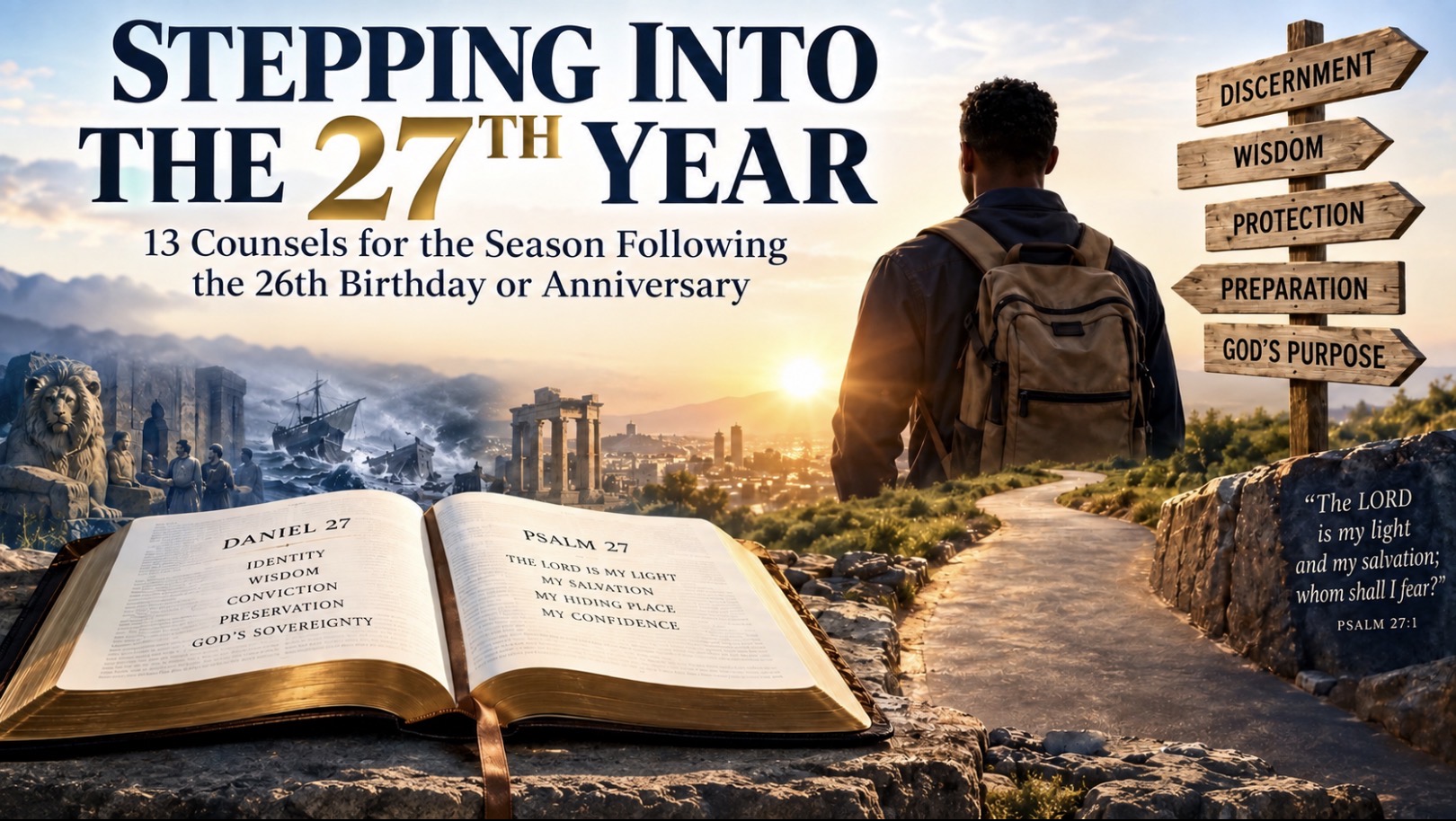
Completing twenty-six years and stepping into the twenty-seventh is worth more than a celebration. Whether you are marking your twenty-sixth birthday, your twenty-sixth wedding anniversary, or the twenty-sixth anniversary of a ministry, church, business, organization or other important undertaking, the transition provides an opportunity to reflect on what has been built, what has been learned, what may need to change, and how the next season should be approached.
One useful way of preparing for the twenty-seventh year is to examine the twenty-seventh book and the twenty-seventh chapters of the Bible and ask what wisdom, warnings and patterns of life emerge from them. The twenty-seventh book in the standard Protestant arrangement of Scripture is Daniel. It is a remarkable book of identity, conviction, wisdom, dreams and visions, changing kingdoms, political pressure, prayer, persecution, strategic conduct, miraculous preservation and the sovereignty of God over human affairs.
The twenty-seventh chapters of Scripture contribute several other important themes. Genesis 27 deals with identity, disguise, deception, blessing and family conflict. Numbers 27 records the case of Zelophehad’s daughters concerning inheritance and later the commissioning of Joshua as Moses’ successor. Psalm 27 is a powerful declaration of confidence in God and even speaks of being hidden by Him in a time of trouble. Jeremiah 27 addresses political authority and God’s dealings with nations. Ezekiel 27 laments the fall of prosperous and commercially powerful Tyre. Matthew 27 records the crucifixion of Jesus, including the tearing of the temple veil. Acts 27 recounts Paul’s dangerous voyage to Rome, the violent storm, the destruction of the ship and the preservation of every life on board.
These passages should not be treated as a rigid formula predicting exactly what will happen during anyone’s twenty-seventh year. Scripture does not teach that human lives are mechanically governed by chapter numbers. Neither should anyone approach a birthday or anniversary with fear because of what happened in a particular chapter of the Bible. What Scripture does provide, however, are recurring principles, warnings, patterns and testimonies from which wisdom can be drawn.
As you step beyond the twenty-sixth birthday or anniversary and enter the twenty-seventh year, the following thirteen counsels may help you approach the new season with greater wisdom, preparation and confidence in God.
1. KNOW WHO YOU ARE AND GUARD YOUR IDENTITY
Identity is one of the strongest issues that emerges from the twenty-seventh book and chapters of the Bible.
Genesis 27 contains one of Scripture’s best-known accounts of impersonation. Jacob entered Isaac’s presence pretending to be Esau. He wore Esau’s clothes, while Rebekah covered his hands and the smooth part of his neck with goatskins so that his father would mistake him for his brother. Isaac heard Jacob’s voice but felt what appeared to be Esau’s hands. A blessing intended for one identity was obtained by someone presenting himself under another identity.
The book of Daniel presents identity under pressure from a different direction. Daniel, Hananiah, Mishael and Azariah were removed from Judah and taken into Babylon. They were given Babylonian names, educated in Babylonian literature and prepared for service within a foreign empire. Almost everything about their external environment changed, but they refused to allow Babylon to redefine their deepest allegiance.
The twenty-seventh year is therefore an appropriate time to ask fundamental questions about identity. After twenty-six completed years, who have you become? What convictions define you? What values have survived the journey? What must never be surrendered merely to gain acceptance, opportunity, advancement or applause?
Growth sometimes requires adaptation. Marriage changes people. Leadership changes people. Business success introduces new responsibilities. Ministry growth may require new methods. New environments may demand new skills. Maturity itself should change the way we think and behave. But healthy adaptation does not require the loss of essential identity.
Do not spend the twenty-seventh year becoming an imitation of somebody else. Learn from others, but do not disappear inside their identities. Know what you stand for, what you represent and what values must govern the next stage of your life, marriage, ministry or organization.
2. DEVELOP GREATER DISCERNMENT
Isaac’s experience in Genesis 27 provides a lasting warning about appearances and conflicting evidence. He sensed that something was wrong. The voice sounded like Jacob, although the hands appeared to be Esau’s. He questioned the situation, but he proceeded without fully resolving the contradiction before him. His physical blindness became part of a larger failure to discern what was actually happening.
The twenty-seventh year should therefore be entered with a commitment to see beyond appearances. Not every opportunity is what it first appears to be. Not every enthusiastic supporter is necessarily a trustworthy partner. Not every criticism is destructive, and not every compliment is sincere. A profitable proposal can contain hidden liabilities. An attractive relationship can conceal serious incompatibilities. An apparently minor decision can produce consequences that last for years.
After twenty-six completed years, experience should increasingly produce the ability to recognize patterns, ask better questions, investigate more carefully and distinguish substance from presentation. Maturity is not merely knowing more; it is learning to interpret what you see.
Do not hurry through important decisions simply because something looks attractive. Examine relationships, contracts, investments, opportunities and assumptions. Where important pieces of evidence appear to contradict one another, investigate further.
Genesis 27 leaves us with an unforgettable picture: when the voice and the hands are telling different stories, do not ignore the contradiction merely because one part of the evidence feels convincing.
May your twenty-seventh year be marked by clearer judgment, greater perception and the wisdom to distinguish appearance from reality.
3. KNOW WHAT TO REVEAL AND WHAT TO CONCEAL
The twenty-seventh book and chapters present an important tension between concealment and revelation. Some things need to be brought into the light, while other things are safest when they remain appropriately hidden.
Matthew 27 records that when Jesus died, the veil of the temple was torn in two from top to bottom. What had stood as a barrier was opened. The book of Daniel likewise contains repeated unveilings. Dreams are interpreted, mysteries are disclosed and hidden matters are brought into the light. These passages remind us that there are situations in which concealment must end. Problems cannot always be solved while they remain hidden. Sin, financial disorder, unresolved conflict, destructive habits, leadership failures and other serious matters sometimes require honest acknowledgement before healing and correction can begin.
Yet Scripture also demonstrates that concealment itself is not always wrong. There are times when wisdom requires discretion.
Esther initially concealed her nationality and family background because Mordecai instructed her not to disclose them. Nehemiah arrived in Jerusalem with a mission from God, yet he did not immediately announce everything he intended to do. He inspected the broken walls at night and later explained that the officials did not initially know where he had gone or what he was doing. Proverbs observes that the prudent see danger and take refuge. Jesus told His disciples to combine innocence with wisdom.
Psalm 27 itself contributes another striking dimension. David declares, “For in the time of trouble He shall hide me in His pavilion; in the secret place of His tabernacle He shall hide me.” Hiding, in this context, is not deception. It is protection.
David’s experience in 1 Samuel 27 also illustrates the complexity of operating in a hostile environment. While fleeing Saul and living among the Philistines, David could not safely disclose everything about his movements and activities to Achish. His circumstances demanded unusual caution. The passage should not be turned into a general licence for dishonesty, but it does remind us that survival in dangerous environments sometimes involves guarded information, strategic silence and limited disclosure.
Genesis 27 presents the darker side of concealment. Jacob hid his identity and impersonated Esau in order to obtain Isaac’s blessing. His actions caused serious pain to Esau and deepened division within the family. Although God’s previously declared purpose concerning Jacob was ultimately fulfilled, the deception itself should not therefore be treated as commendable. God’s sovereignty over human failure must never become an excuse for wrongdoing.
The lesson for the twenty-seventh year is therefore broader than simply bringing hidden things into the open. You must develop wisdom concerning what should be revealed, what should be confronted, what should remain confidential and what should not yet be disclosed.
Not everybody has a right to every piece of information about your life. A business should protect legitimate trade secrets, sensitive negotiations and intellectual property. An organization must safeguard confidential information. Ministers and counsellors must protect appropriate confidences. Governments maintain intelligence and security operations because indiscriminate disclosure could defeat their purpose or endanger lives. Individuals also require boundaries concerning personal information, plans, vulnerabilities and relationships.
There are occasions when announcing a plan too early exposes it unnecessarily to opposition, interference or misunderstanding. Some dreams need time to mature before they are discussed widely. Some negotiations must remain confidential until agreements are completed. Some information entrusted to you belongs to another person and is not yours to disclose.
At the same time, secrecy becomes dangerous when it is used to protect wrongdoing. Confidentiality must not become an excuse for covering abuse, corruption, fraud, manipulation or conduct that places other people in danger. Neither should spiritual language about “wisdom,” “privacy” or “confidentiality” be used to avoid legitimate accountability.
The twenty-seventh year therefore calls for mature discernment concerning disclosure.
Do not expose what wisdom requires you to protect, and do not hide what righteousness requires you to confront.
Know when to speak and when to remain silent. Know when transparency is necessary and when confidentiality is responsible. Know when a veil needs to come down and when a covering is providing legitimate protection.
May God give you the wisdom in your twenty-seventh year to recognize the difference.
4. PREPARE FOR TRANSFERS AND NEW RESPONSIBILITIES
Numbers 27 contains two significant forms of transfer. The daughters of Zelophehad approached Moses because their father had died without a son, and they raised the question of his inheritance. God affirmed their claim and established principles concerning inheritance in Israel. Later in the same chapter, Moses was instructed to commission Joshua, publicly preparing him to assume leadership after Moses.
Genesis 27 also revolves around transfer—the transfer of a patriarchal blessing—although in that case deception and family conflict complicated the process.
Together, these passages draw attention to an important reality of life: responsibilities, opportunities, authority, possessions and influence eventually change hands.
The twenty-seventh year may therefore be an important season for preparing for new responsibilities, succession, inheritance, ownership or opportunity. For someone celebrating a birthday, this may mean greater responsibility for career, finances, family or leadership. For a marriage, it may involve a new phase relating to children, property, business, caregiving or extended family responsibilities. For a ministry, church, business or organization, it may involve delegating authority, developing younger leaders, expanding departments, strengthening governance or intentionally preparing successors.
Do not merely desire promotion. Develop the capacity required to carry what comes with it.
Joshua had spent years around Moses before leadership was formally transferred to him. Public commissioning did not create his preparation; it recognized and advanced a process that had already been taking place.
Use your twenty-seventh year to become ready for legitimate transfers. Strengthen your competence. Document important knowledge. Clarify responsibilities. Develop successors. Improve systems. Learn what you need to know before the opportunity or responsibility arrives.
May what should rightfully come into your hands find you prepared to steward it well.
5. BECOME MORE VALUABLE THROUGH PROBLEM-SOLVING WISDOM
One of Daniel’s distinguishing qualities was his ability to respond wisely to difficult problems.
When Nebuchadnezzar demanded that his wise men reveal both his dream and its interpretation, Babylon’s established experts reached the limits of their ability. Their failure placed their lives in danger. Daniel responded differently. He sought time, involved his companions, sought God in prayer and received the revelation needed to answer the king. A crisis that threatened his life eventually became an occasion for greater responsibility and influence.
This provides a powerful counsel for the twenty-seventh year: increase your usefulness.
Many people seek promotion without asking what problems they have become capable of solving. Yet responsibility often moves toward people who can be trusted when ordinary answers are insufficient.
Ask yourself: What can I do today that I could not do five years ago? What kinds of problems can people confidently bring to me? What knowledge, skill, wisdom or discipline should I acquire during this new season? Where am I still depending on yesterday’s competence for tomorrow’s responsibilities?
If this is your twenty-seventh year of life, deepen your professional and practical abilities. If it is the twenty-seventh year of a marriage, improve your ability to solve problems together rather than repeatedly recycling the same disagreements. If it is the twenty-seventh year of a ministry, business or organization, become more capable of identifying and addressing the real needs of the people you serve.
Daniel’s greatness was not based merely on visions. He was also a disciplined, trusted and highly competent administrator.
May your twenty-seventh year increase both the number and the quality of problems you are equipped to solve.
6. REMAIN HUMBLE WHEN SUCCESS INCREASES
The book of Daniel contains some of Scripture’s strongest warnings about pride.
Nebuchadnezzar became extraordinarily powerful, but eventually looked upon Babylon and attributed its greatness to his own power and glory. His subsequent humiliation confronted him with the reality that human authority remains subject to God. Belshazzar later failed to learn sufficiently from what had happened to Nebuchadnezzar, and his kingdom came to an abrupt end.
Ezekiel 27 adds another warning through its lament over Tyre. Tyre was wealthy, commercially successful and internationally connected. Its ships, merchants and trading relationships reflected extraordinary prosperity, yet neither wealth nor global influence made it permanent.
This is an important counsel for anyone entering the twenty-seventh year after significant progress. Perhaps the previous years have produced financial improvement, professional advancement, a growing family, an expanding ministry, a successful business or increasing influence. Give thanks for progress, but do not allow achievement to produce arrogance or self-sufficiency.
Success carries its own dangers. It can create the illusion that yesterday’s victories guarantee tomorrow’s results, that present influence will last indefinitely or that the people and principles that helped us rise are no longer necessary.
Remain teachable. Maintain accountability. Listen to correction. Treat people with dignity. Continue learning. Remember where you came from and acknowledge the grace, opportunities, relationships and help that contributed to your journey.
The twenty-seventh reminds us that greatness is safest in the hands of those who remember that they are still human.
May your twenty-seventh year bring elevation without pride, influence without arrogance and success without the loss of humility.
7. STAND FIRMLY FOR YOUR CONVICTIONS
Daniel and his companions repeatedly had to decide whether success in Babylon was worth compromising their convictions.
Daniel resolved not to defile himself with the king’s provisions. Shadrach, Meshach and Abednego refused to worship Nebuchadnezzar’s golden image. Years later, Daniel continued his established practice of prayer even when a royal decree made doing so dangerous.
Their example is particularly instructive because they were neither incompetent nor needlessly rebellious. Daniel served government with excellence. His convictions did not make him careless, disrespectful or irresponsible in the performance of his duties.
The twenty-seventh year may likewise test what you truly believe. Opportunities sometimes arrive with conditions. Relationships create pressure. Career advancement can test integrity. Success may introduce environments where long-held convictions are treated as inconvenient, old-fashioned or negotiable.
Decide beforehand what must not be exchanged for advancement.
For a marriage, protect the values upon which your union was built. For a ministry or church, resist the temptation to abandon conviction merely to become fashionable or popular. For a business or organization, do not trade ethical standards for short-term financial gain.
Courage becomes easier when convictions have been settled before the crisis arrives.
May your twenty-seventh year strengthen your ability to remain gracious without becoming weak, adaptable without becoming compromised, and courageous without becoming needlessly confrontational.
8. LEARN TO GOVERN YOUR APPETITES
Food occupies a curious but significant place in several passages associated with the twenty-seventh.
Isaac’s desire for a particular meal forms part of the setting in which the events of Genesis 27 unfold. The book of Daniel begins with Daniel and his companions placing boundaries around what they would consume. In Acts 27, after many difficult days at sea, Paul urged those aboard the ship to eat because they needed strength to survive what lay ahead.
The wider lesson concerns appetite, discipline and self-control.
Every person has appetites. We desire food, money, pleasure, recognition, influence, possessions, companionship, comfort and success. None of these desires is automatically wrong, but desire becomes dangerous when it begins to govern judgment.
By the twenty-seventh year, tendencies once dismissed as youthful impulses may already be developing into established patterns. This is therefore a good season to ask what has gained too much control over you.
Financial appetite can produce unnecessary debt. The appetite for recognition can generate unhealthy competition. The hunger for success can damage marriages, friendships and families. The pursuit of pleasure can undermine long-term purpose. Even the desire for achievement can become destructive when a person no longer knows when to stop, rest or say no.
The same principle applies to institutions. Organizations can pursue expansion so aggressively that they destroy the culture that made them healthy. Ministries can become preoccupied with numbers or visibility. Businesses can become obsessed with growth at the expense of people, values or integrity.
The twenty-seventh year should therefore be a season of disciplined desire. Know when to pursue, when to restrain, when to enjoy and when to abstain.
Enjoy what God provides, but never allow appetite to become your master.
9. EXPECT SOME SITUATIONS TO REQUIRE MORE THAN YOUR PRESENT KNOWLEDGE
Daniel repeatedly encountered problems that exceeded conventional expertise.
Babylon had wise men, advisers, astrologers and specialists, yet there were mysteries they could not solve. Daniel himself later received visions whose meanings he did not immediately understand and for which further explanation was required.
The twenty-seventh therefore reminds us to prepare for complexity.
After twenty-six years, it can be tempting to assume that experience has already supplied answers for most situations. In reality, every new season eventually introduces questions that yesterday’s experience cannot fully answer. A new stage of marriage may require different wisdom from the early years. A growing organization can develop problems that never existed while it was small. Career advancement can place someone in situations beyond previous training. Parenting adult children requires a different approach from parenting young children.
Do not be ashamed of what you do not know. The dangerous person is not the one who lacks an answer, but the one who refuses to admit that a better answer is needed.
Learn. Read. Ask questions. Seek counsel. Consult people with greater experience. Acquire new skills. Pray for wisdom.
Daniel combined serious learning with serious dependence upon God. He did not use prayer as an excuse for ignorance, nor did he allow education to make him spiritually self-sufficient.
May your twenty-seventh year enlarge both your knowledge and your humility.
10. PREPARE FOR PRESERVATION IN DIFFICULT SEASONS
Acts 27 contains one of Scripture’s most dramatic stories of crisis and preservation.
Paul was travelling to Rome as a prisoner when the ship encountered a violent and prolonged storm. Cargo was thrown overboard. Equipment was discarded. For many days neither sun nor stars appeared, and hope of survival diminished. Eventually the ship itself was destroyed.
Yet every person aboard reached land alive.
Acts 27 therefore reveals an important truth about preservation: sometimes God preserves the people even when the structure cannot be preserved.
The twenty-seventh year is consequently a good season for strengthening resilience. Build emergency savings where possible. Reduce unnecessary financial exposure. Protect important documents. Back up valuable information. Maintain appropriate insurance where applicable. Strengthen health habits. Develop contingency plans. Reduce dependence upon a single person, customer, system or source of income where doing so is possible.
Preparation is not unbelief. Biblical faith has never required carelessness.
Joseph prepared Egypt for famine because God had revealed what was coming. Noah built an ark because he believed God’s warning. Paul believed that the lives of those aboard would be preserved in Acts 27, yet he still gave practical instructions concerning what they should do.
Sometimes wisdom does not merely ask, “How do we make sure nothing ever goes wrong?” It asks a more realistic question: “If something does go wrong, what must survive?”
May your twenty-seventh year be marked by divine preservation, wise preparation and the resilience to survive disruption without losing what matters most.
11. BUILD HEALTHY COLLABORATIONS
The twenty-seventh repeatedly demonstrates the power of collaboration.
Rebekah and Jacob worked together in Genesis 27, although their objective and method were morally wrong. Daniel turned to Hananiah, Mishael and Azariah when their lives were threatened and asked them to seek God’s mercy concerning Nebuchadnezzar’s mystery. First Chronicles 27 presents another picture of shared responsibility, showing David’s kingdom administered through commanders, officers, tribal leaders and others entrusted with different areas of responsibility.
The principle is clear: significant work usually requires other people.
Entering the twenty-seventh year with an indispensability mentality can become a serious limitation. If nobody else can perform important responsibilities in your organization, you have probably not built strongly enough. If a marriage depends almost entirely upon one spouse carrying every responsibility, greater cooperation may be needed. If a business cannot function whenever the founder is absent, systems and delegation require attention.
Build relationships with people whose strengths complement yours. Learn to distribute responsibility without abandoning accountability. Give others room to develop competence. Create structures that allow a family, ministry, business or organization to become stronger than the capacity of one individual.
At the same time, discern partnerships carefully. Collaboration multiplies the purpose and character of those involved. Rebekah and Jacob collaborated effectively, but their effectiveness does not make their deception commendable.
Choose partners not merely because they are capable or useful, but because their character, values and objectives can coexist with yours.
May your twenty-seventh year bring trustworthy relationships, healthy teams and partnerships capable of carrying responsibilities that would be too heavy for you alone.
12. ACCEPT THAT PEOPLE, POSITIONS AND SYSTEMS CHANGE
The book of Daniel is a great reminder that earthly power is temporary.
Kings rise and disappear. Empires dominate and eventually become history. Political structures change. Yet Daniel serves through different administrations while remaining anchored in something greater than the governments around him.
Jeremiah 27 likewise places political authority within a larger divine perspective, reminding its original hearers that nations and rulers do not possess permanent power.
This counsel becomes increasingly important as the years pass. One of maturity’s greatest lessons is that very few human arrangements remain unchanged forever.
People relocate. Leaders retire. Parents age. Children grow. Careers change. Organizations restructure. Markets shift. Relationships enter new stages. Influence moves from one generation to another. Methods that once produced results can eventually become inadequate.
Do not build your entire security upon something that was never designed to be permanent.
Value people without idolizing them. Honour leaders without imagining that they will occupy their positions forever. Build organizations capable of surviving transitions. Prepare successors. Document knowledge. Remain willing to learn new methods, and recognize when an old structure has completed its usefulness.
Change does not always mean that something has gone wrong. Sometimes change simply means that a season has fulfilled its purpose and another phase must begin.
May your twenty-seventh year give you the wisdom to recognize what should be preserved, what should be released and what should be allowed to change.
13. ENTER THE TWENTY-SEVENTH YEAR WITH CONFIDENCE IN GOD
Psalm 27 provides perhaps the most appropriate final word for this season:
“The LORD is my light and my salvation; whom shall I fear?”
The twenty-seventh book and chapters contain many difficult environments. Genesis 27 contains family conflict and deception. Daniel contains political threats, fiery furnaces, hostile conspiracies and a den of lions. Ezekiel 27 describes the collapse of prosperous Tyre. Matthew 27 records suffering and crucifixion. Acts 27 contains imprisonment, storm and shipwreck.
Yet fear is not the governing message of these passages.
Daniel survives. His companions survive the furnace. Paul survives the sea. Psalm 27 speaks confidently in the presence of enemies and adversity. Even Matthew 27, which records the crucifixion, stands within the larger Gospel story in which death does not have the final word.
Psalm 27 also gives us another image of confidence: God does not merely strengthen His people in difficulty; sometimes He hides them. “In the secret place of His tabernacle He shall hide me.” There are seasons when divine protection may involve visibility and seasons when it may involve concealment. Confidence in God includes trusting Him to guide both.
The twenty-seventh year should therefore not be approached anxiously, as though something bad must happen because of the number twenty-seven. Such an approach would completely miss the purpose of drawing wisdom from these passages.
The appropriate response is confident preparation.
Make wise decisions. Strengthen your systems. Develop discernment. Correct weaknesses. Protect what should be protected. Reveal what should be confronted. Prepare for opportunities. Build relationships. Govern your appetites. Remain humble. Continue learning. Then trust God.
You cannot know everything that the next year will contain, but you can decide what kind of person you intend to be when its circumstances arrive.
May your twenty-seventh year be one in which your confidence in God becomes deeper than your circumstances.
A PRAYER AND BLESSING FOR THE TWENTY-SEVENTH YEAR
As you step beyond the twenty-sixth birthday or anniversary and enter the twenty-seventh year, may God give you clarity concerning who you are and what you have been called to represent. May you grow and adapt without losing your identity, and may you be protected from deception, impersonation and relationships built upon false appearances.
May God sharpen your discernment. Where evidence is confusing, may you receive wisdom. Where something important needs to be revealed, may truth come into the light in a manner that produces healing, correction and progress rather than destruction. Where wisdom requires confidentiality, discretion or protection, may you know what should remain hidden and for how long.
May God teach you what to reveal and what to conceal. May you not expose yourself, your plans, your responsibilities or other people’s confidential matters unnecessarily. May you also never use secrecy to protect wrongdoing, avoid legitimate accountability or conceal what righteousness requires you to confront. May you know when to speak, when to remain silent, when to open the door and when to guard it.
May legitimate transfers locate you. May responsibilities for which you have been prepared come into your hands. May you receive wisdom to recognize opportunities, competence to carry them and humility to steward them well.
May your ability to solve problems increase. When others encounter situations that appear difficult or impossible, may God give you understanding, creativity, knowledge and insight. May your preparation create room for advancement, and may promotion never separate you from humility.
May your convictions survive pressure. May fear, ambition or opportunity never compel you to surrender what you know to be right. May you receive grace to remain respectful without becoming compromised and courageous without becoming reckless.
May God give you mastery over unhealthy appetites. May no craving, ambition, pleasure, possession or desire become powerful enough to govern your destiny.
When unfamiliar situations arise, may you know where to turn for wisdom. May God connect you with wise people, enlarge your understanding and teach you to combine learning, prayer, experience and sound judgment.
May you be preserved. Where storms arise, may your life, faith and purpose survive them. Where some things must be released, may you have wisdom to distinguish what can be sacrificed from what must be protected. Where necessary, may God hide you in His pavilion and keep you in the secret place of His protection.
May God surround you with trustworthy collaborators. May your relationships become sources of strength rather than unnecessary conflict. May you build families, teams and systems capable of carrying responsibilities beyond your individual strength.
As people, positions and circumstances change, may you remain stable in God. May you not be destroyed by the departure of a person, the end of a position, the failure of a structure or the transition from one season into another.
Above all, may the testimony of Psalm 27 become increasingly real in your life. May the Lord be your light when you need direction, your salvation when you need deliverance, your hiding place when you need protection and your strength when circumstances attempt to produce fear.
CONCLUSION
Stepping into the twenty-seventh year is an invitation to greater maturity.
Twenty-six completed years have already supplied experiences, victories, disappointments, relationships, mistakes, lessons and responsibilities. The next year should not merely repeat what came before it. It should benefit from what the previous years have taught.
The twenty-seventh book and chapters of the Bible call attention to identity, discernment, revelation, concealment, transfer, wisdom, humility, conviction, self-control, collaboration, preservation, transition and confidence in God. They remind us that appearances can deceive, some hidden things need to be brought into the light, other things require legitimate protection, responsibilities can change hands, success can become dangerous when pride enters, and difficult problems can become opportunities for people who have prepared themselves.
They teach us that maturity does not mean telling everyone everything. Neither does wisdom mean hiding everything. Sometimes the veil must come down. Sometimes the pavilion must provide covering. Sometimes truth must be spoken openly. Sometimes information must be guarded carefully. The challenge is to know the difference.
They also remind us that changing circumstances do not necessarily destroy purpose.
The ship can break while the people survive. A government can change while Daniel remains useful. An environment can change without taking away your identity. Pressure can increase without forcing you to surrender your convictions. Something familiar can end while God’s purpose for your life continues.
Therefore, as you celebrate the completion of twenty-six years and step into the twenty-seventh, do more than count another year. Know who you are. See clearly. Know what to reveal and what to protect. Deal honestly with what requires correction. Prepare for legitimate transfers. Increase your usefulness. Remain humble. Guard your convictions. Govern your appetites. Keep learning. Build resilience. Strengthen healthy relationships. Prepare wisely for change. Above all, place your confidence firmly in God.
May the twenty-seventh year bring greater wisdom, clearer vision, responsible advancement, trustworthy relationships, strategic discretion, divine preservation and the grace to carry whatever the new season places in your hands.
