


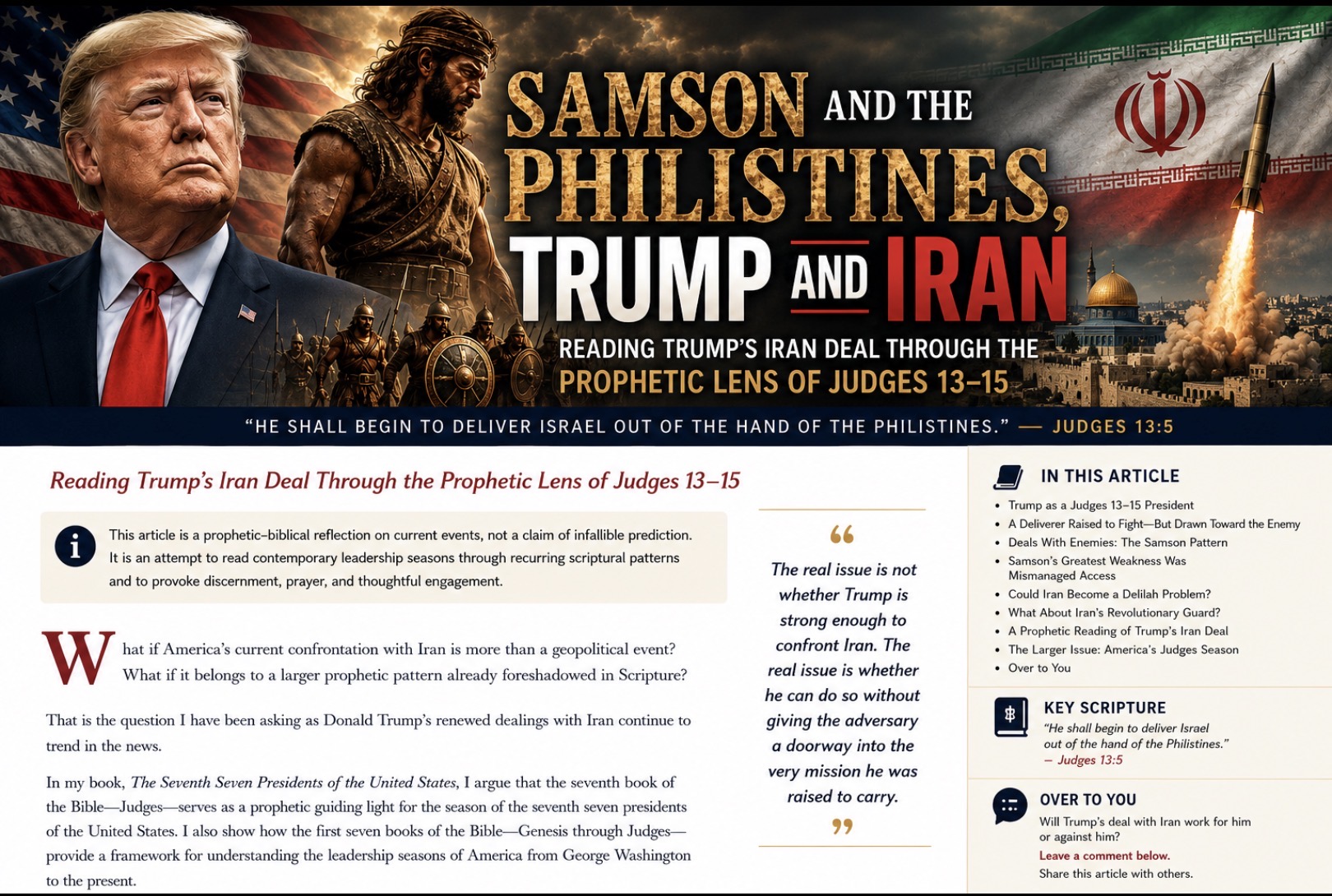
Editorial Note: This article is a prophetic-biblical reflection on current events, not a claim of infallible prediction. It is an attempt to read contemporary leadership through recurring scriptural patterns and to provoke discernment, prayer, and thoughtful engagement.
What If Trump’s Deal with Iran Is More Than Geopolitics?
What if America’s present confrontation with Iran belongs to a larger prophetic pattern already foreshadowed in Scripture? That is the question I have been sitting with as Donald Trump’s renewed dealings with Iran continue to make headlines.
In my book, The Seventh Seven Presidents of the United States, I showed how the first six books of the Bible — Genesis through Joshua — provide a framework for understanding America’s leadership seasons from George Washington to Bill Clinton. I then showed that the seventh book, Judges, serves as a prophetic guide for the season of the seventh seven presidents.
At the time of writing, America has seen five of those seven presidents: George W. Bush, Barack Obama, Donald Trump as the 45th president, Joe Biden, and Donald Trump again as the 47th. Two more — the 48th and 49th — are yet to emerge. In that framework, each president corresponds to three chapters in Judges:
- George W. Bush — Judges 1–3
- Barack Obama — Judges 4–6
- Donald Trump (45th) — Judges 7–9
- Joe Biden — Judges 10–12
- Donald Trump (47th) — Judges 13–15
- 48th President — Judges 16–18
- 49th President — Judges 19–21
That means Trump’s current season as the 47th president falls within Judges 13–15 — the opening chapters of Samson’s story. And that raises a serious question: Could Trump’s present dealings with Iran be read through the Samson pattern?
Trump as a Judges 13–15 President
Judges 13–15 introduces Samson as a man born into national crisis. Israel was under Philistine oppression, and Samson was raised up by God to begin its deliverance. The angel of the Lord announced his assignment before birth:
He shall begin to deliver Israel out of the hand of the Philistines.(Judges 13:5)
Samson’s calling was not primarily personal — it was national. He was born for conflict, raised for confrontation, and anointed to strike a hostile power that had dominated God’s people. Notably, there were also prophetic words preceding Trump’s presidency.
Whatever one thinks of Trump politically, his public role has consistently unfolded in conflict mode — against internal opposition, entrenched institutions, and external adversaries. His season has the feel of a Samson season: combative, disruptive, unconventional, marked by direct confrontation with enemies. If that reading holds, then Iran deserves close attention.
Samson Was Raised to Fight the Philistines — Not to Join Himself to Them
One of the striking tensions in Samson’s story is this: the very people he was raised to confront became the people he repeatedly moved toward relationally. He desired a Philistine woman in Timnah. He moved among the Philistines, engaging them personally, emotionally, and strategically. The enemy was not only on the battlefield — the enemy became intertwined with his private choices.
That tension matters. A deliverer can be genuinely raised up for battle and still mishandle proximity to the power he is called to confront. A leader can be anointed for resistance and yet create openings through unnecessary entanglement. A man can be strong in warfare and weak in judgment.
This is one reason Trump’s relationship with Iran warrants prophetic scrutiny. The real issue is not simply whether Trump is strong enough to confront Iran. The deeper issue is whether he can engage that arena without giving the adversary a doorway into the very mission he was raised to carry.
Deals with Enemies: The Samson Pattern
Judges 14–15 shows that Samson’s conflicts with the Philistines were not abstract military clashes. They were entangled with relationships, negotiations, broken arrangements, and retaliations. Samson proposed a riddle at his wedding feast. The Philistines manipulated his wife to extract the answer. A personal relationship became the channel through which the enemy gained leverage — what looked like a social arrangement became a site of betrayal and strategic loss.
The conflict then escalated. Samson’s wife was given to another man. Samson retaliated. The Philistines retaliated again. The cycle deepened. By Judges 15, the story had become a chain of violated trust, vengeance, and national conflict.
The Samson narrative is not only about brute strength. It is about the danger of operating in the orbit of an enemy whose values, loyalties, and intentions remain fundamentally opposed to your assignment. That is where the Trump–Iran question becomes especially weighty. If Trump is living through a Samson-pattern season, then his dealings with Iran may not merely be diplomatic events. They may become tests of whether strength can operate without compromise, whether confrontation can avoid entanglement, and whether negotiation can be pursued without strategic seduction.
Samson’s Greatest Weakness Was Mismanaged Access
Samson was not destroyed first by a lack of power. He was destroyed by mismanaged access. Before Delilah appeared in Judges 16, the warning signs were already present in Judges 13–15. Samson kept stepping too close to what should have been handled with greater separation and discernment. His downfall did not begin when his hair was cut — it began when boundaries were repeatedly weakened.
That pattern deserves attention in any discussion of Trump and Iran.
Iran is not simply another nation in the news cycle. It is a deeply ideological state actor with regional ambitions, militant networks, and a history of strategic patience. Its Islamic Revolutionary Guard Corps has functioned as more than a military institution — it has been a vehicle of influence, pressure, and asymmetric conflict across the region.
The question is not simply whether Trump can pressure Iran. The deeper question is whether this season involves a Samson-like test of discernment: Can a leader called to confront an enemy do so without underestimating that enemy’s ability to exploit weakness, fracture alliances, manipulate timing, or weaponize negotiation itself?
Samson teaches that the greatest danger to a deliverer may not be open warfare — it may be unguarded engagement with the very power he is meant to weaken. This is precisely why God commanded Israel not to intermarry or enter into treaties with the Canaanites when they went to possess the Promised Land.
Could Iran Become a Delilah Problem?
I want to say this carefully. I am not claiming Iran is Delilah, nor that every diplomatic engagement is automatically a betrayal. But the Samson narrative does warn us about the spiritual logic of enemy entanglement.
In Samson’s life, the enemy eventually moved from external opposition to internal access. The Philistines could not defeat him by force alone, so they sought another route — studying his appetites, exploiting relational openings, pressing until strength and vulnerability met in the same room.
That is the warning. Samson’s story tells us that a leader can win public battles and still lose the war through private vulnerabilities, misjudged relationships, or the wrong kind of deal with the wrong kind of adversary.
Where Does Israel Stand in a Trump–Iran Deal?
If Trump is, in prophetic terms, a Samson-like figure in this season — raised into confrontation with a hostile power — then Israel occupies the place of the covenant people whose security is bound up with the outcome of that confrontation. Samson was not raised merely to prove his strength. He was raised because Israel was under Philistine pressure. His calling was connected to the preservation and deliverance of a people living under threat.
Trump has long presented himself as one of Israel’s strongest modern allies, with his political identity in the Middle East tied to pro-Israel policy and open resistance to Iran’s regional ambitions. Iran, meanwhile, has functioned as one of the chief state sponsors of the threats arrayed against Israel — through missile development, regional proxies, anti-Israel rhetoric, and strategic encirclement.
Any U.S.–Iran understanding therefore raises a sobering question: does the deal weaken the enemy confronting Israel, or does it restrain Israel while giving Iran room to survive, regroup, and reposition?
Samson’s danger was not only that he fought the Philistines — it was that he could engage them in ways that complicated the very mission for which he had been raised. The deeper risk was becoming entangled in an arrangement that made it harder to fully carry out the assignment of deliverance.
If a Trump deal with Iran lowers immediate tensions but leaves the deeper anti-Israel threat structure substantially intact, Israel may find itself in the most uncomfortable position of all — publicly defended by America, yet strategically constrained by America at the same time.
Trump could still claim the role of peacemaker and dealmaker. But Israel might find itself asking whether the deal actually secures its future or merely pauses conflict while preserving the architecture of the next one. A deal that genuinely curbs Iran’s capacity to arm proxies, threaten Israeli cities, or accelerate its nuclear ambitions would be one thing. A deal that buys short-term quiet while leaving Israel to live with a stronger, richer, or diplomatically rehabilitated adversary would be something very different.
In that case, Israel would not stand as the beneficiary of the arrangement — but as the party expected to absorb its long-term risk.
So where does Israel stand in a U.S.–Iran deal? That depends entirely on whether the deal is a weapon against the Philistine threat — or a relationship with the Philistines that eventually complicates the mission of deliverance itself.
Beginning, Not Completing
Samson’s assignment was not to complete Israel’s deliverance in a single moment. The angel said, “He shall begin to deliver Israel.” That word is important. Samson’s role was initiatory — he was raised to begin a disruption of Philistine domination.
That may be the most fitting lens for Trump’s season as the 47th president. If this truly is a Judges 13–15 moment, the issue may not be whether every hostile structure collapses immediately. It may be whether this season begins a larger unraveling, exposes hidden fault lines, or initiates pressures that outlast the moment itself.
Trump’s dealings with Iran may be one episode in a much larger drama — about America’s moral direction, her confrontation with enemies abroad, her instability at home, and her need for leaders who can fight without being captured by the very forces they oppose.
Some battles are won by knowing where not to bind yourself, whom not to trust, and how not to give the adversary access to your calling. Samson’s story is as much a warning as it is a story of power. Trump’s present season may be the same.
PRAYER POINTS
Pray for President Trump – for divine direction and wisdom and for humility to follow helpful counsel.
Pray that Israel will continue to hope in God and rely on His Strength and Wisdom in the present conflict. Pray for the preservation and peace of Israel.
Pray that true freedom and peace and prosperity will return to Iran.
Pray that grounds already gained for good in this Israel-US-Iran conflict will not be lost.
Over to You
- Do you think Trump’s current dealings with Iran will work for him or against him?
- Do you see a real Samson–Philistine pattern here?
- Could Iran become a Delilah-type vulnerability in Trump’s 47th-presidency season?
- Or will this confrontation ultimately strengthen Trump and weaken Iran’s regional influence?
Leave a comment below.
If this article stirred your thinking, share it with others and invite them into the conversation..
